Legal analysis
Legal Data Analysis: How Law Firms and Compliance Teams Make Faster, Smarter Decisions
Legal data analysis is reshaping how law firms, corporate legal teams, and compliance departments make decisions.
When legal teams move beyond manual review and leverage structured analysis of case data, contracts, and regulatory records, they unlock faster risk insight, smarter resource allocation, and clearer strategic direction.
What legal data analysis covers
– E-discovery and document review: Identifying responsive documents, clustering related materials, and surfacing key custodians and timelines.
– Contract analytics: Extracting clauses, tracking obligations, and benchmarking contract language for faster negotiation and compliance checks.
– Litigation and outcome analysis: Aggregating past case outcomes, court behavior, judge rulings, and timelines to inform settlement strategies and litigation budgeting.
– Compliance monitoring and regulatory reporting: Monitoring transactions and communications for policy violations, maintaining audit trails, and automating routine filings.
– Operational intelligence: Measuring matter profitability, staffing efficiency, and turnaround times to optimize workflows.
Key principles for practical results
– Start with clean, well-governed data. Legal outcomes depend on accuracy. Standardize metadata, normalize naming conventions, and resolve duplicates before analysis begins.
– Blend structured and unstructured sources. Contracts, pleadings, emails, and billing records each tell part of the story. Tools that can ingest both text and tabular data yield the most comprehensive insights.
– Focus on a clear use case.
Choose one high-value problem—reducing discovery costs, accelerating contract review, or improving settlement predictions—and prove value before scaling.
– Maintain attorney oversight.
Automated analysis should augment, not replace, legal judgment.
Use findings to inform strategy, then apply subject-matter expertise to validate decisions.
Choosing tools and vendors
Prioritize solutions with strong connectors to existing systems (matter management, ERP, document repositories) and transparent processing methods. Important vendor capabilities include secure data handling, customizable extraction rules, explainable analytics outputs, and support for exportable audit logs. Evaluate performance on real in-house data during a pilot to validate fit and expected ROI.
Privacy, ethics, and privilege
Legal data analysis carries heightened confidentiality obligations.
Implement strict access controls, encryption in transit and at rest, and role-based review workflows to protect privileged materials. Adopt data minimization—analyze only what’s necessary—and document decisions to support privilege assertions and audit readiness.
Measuring success
Track KPIs that align to business goals:
– Time-to-first-draft for contract review
– Percent reduction in document review hours
– Accuracy of clause extraction versus manual review
– Matter margin improvement after workflow changes
– Compliance incident detection rate and false positive trends
Building skills and culture
Combine technical talent (data analysts, subject-matter engineers) with seasoned lawyers and paralegals. Encourage cross-training so legal staff understand analytic outputs and analysts grasp legal context. Promote small, iterative projects that deliver visible wins to build organizational trust.
Common pitfalls to avoid
– Overreliance on out-of-the-box results without legal validation
– Ignoring change management—new processes need clear roles and training
– Underestimating data preparation effort
– Selecting tools based solely on feature lists rather than real-world pilots
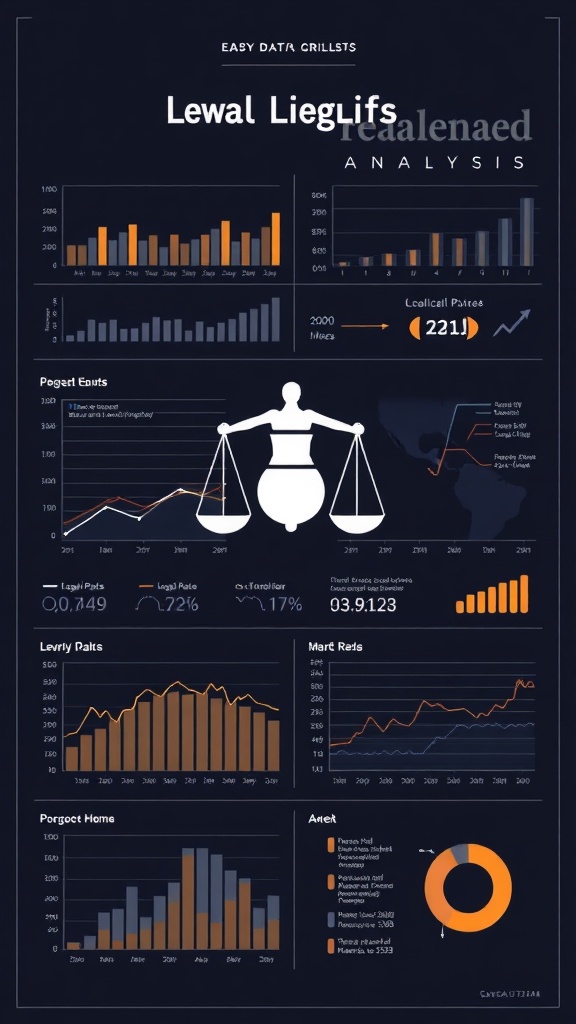
Legal data analysis is no longer an experimental luxury; it’s a practical capability that drives better decisions, reduces cost, and strengthens compliance. With disciplined data governance, pragmatic tool selection, and close collaboration between legal and analytics teams, organizations can turn legal data into a strategic asset that supports faster, smarter legal work.